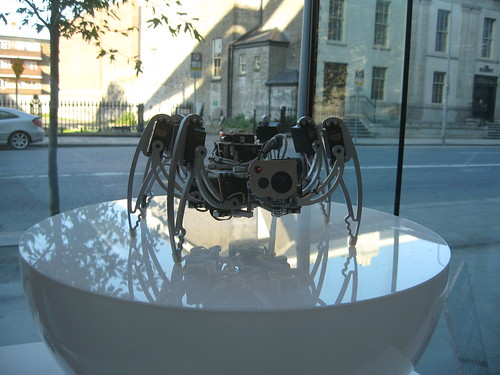
Overall the ArtBots exhibition at the Science Gallery was interesting, even if we didn't get to meet graphic novelist Warren Ellis who was one of the creators. The six-legged creature iC Hexapod by Matt Denton used face recognition to spot people's faces, then tracked them, took a photo and uploaded it to www.hexapodrobot.com. No-one seemed to mind peering into the robot's powerful camera, and having their photo uploaded publicly on the net, yet they would probably have been more embarrassed if they realised that the feed was simultaneously appearing projected onto the wall of the Science Gallery's Flux cafe.
Der Zermesser by Leo Peschta described itself as an 'autonomous, room-filling object'; the sensors of this large, silver pyramidal frame detected floors and walls and moved it around accordingly, changing its shape as it moved slowly around the space.
Matthew Gardiner's Oribotics [Network] recommended using an iPhone to control the movement of its origami-inspired folds, while the egg-shaped Momo by Che-Wei Wang and Kristin O'Friel sat in your hands and 'leaned' towards various sites around Dublin, directing participants towards preprogrammed locations such as Merrion Square.
What It Is Without The Hand That Wields It by Riley Harmon was linked up to the on-line video game and first-person shooter CounterStrike. Each time someone was shot in the fairly graphic game, red liquid would squirt down the wall near the screen, from translucent containers reminiscent of blood transfusion bags, and the message 'A drop of blood has fallen' would appear on the screen. Despite a warning that some of the exhibits weren't suitable for children, one father didn't seem to have quite grasped the point of this piece, and was showing it to his just-older-than-toddler son, saying, 'look at the nice paint'.
The Telematic Drum Circle by Byeong Sam Jeon was fun, allowing you to control a bodhran, a maraca, bells and a djembe through iBooks, with the results streamed to www.telematicdrumcircle.com. This appealed even to those among us with a notorious hatred of drum circles. In general, the ubiquity of Apple products throughout the exhibit gave the impression that being a robot designer without a Mac was some kind of aesthetic sin.
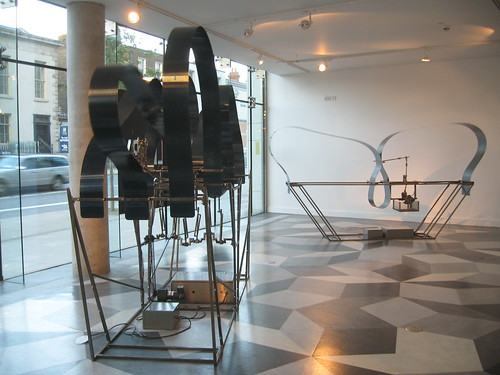
The most striking pieces were two by Jack Pavlik, The Storm and 6 Bands, where large bands of steel moved in flowing curves. Whether these were truly robotic was debatable - they seemed more mechanical, and involved simple sensors to regulate their movements - I've seen similar in sculpture and musical installations. Likewise Gossamer-1 by Koichiro Mori, which drew onto canvas from suspended tubes in response to sound, was something very similar to pieces I've seen in various museums. Rechneder Raum by Ralf Baecker looked quite beautiful. Its description of itself as a calculation machine where the normally invisible calculations are on the large outside but the result is hidden from view in the centre didn't seem to be quite borne out in its presentation, where the central minimally moving red wires were still quite visible as the focus of the piece.
The Search for Luminosity by Allison Kudla on the other hand was one of the most interesting works, but difficult to fully observe. As well as the response to the sun, the oxalis plant has an 'endogenous rhythm' or programmed memory which causes it to lift its leaves to prepare for photosynthesis. The robot detected this lift and switched the light above the plant on, thus putting the light under the control of the plant, rather than the other way around. Interesting but in practice this movement likely takes place over hours, or else the plant remains in one position for a long time, so it wasn't immediately very observable to the gallery audience.
Probably the oddest and most unsettling piece was Two Stage Transfer Drawing (Cyberskin) by Joan Healy, where you moved your hand or finger across a medium to draw in 4 colours on a computer screen. The medium turned out to be actual human skin, the back of a person inside a metal box. Quite a surprise to touch. Disturbingly there were 4 red scratches across the person's back, where only a few minutes earlier apparently someone had deliberately scratched them. But the unseen person was bravely continuing with the piece, which was remarkably accurate in relating the movement to the screen drawing.
Probably my favourite work was Untitled by Chris Kaczmarek, which had four sets of two eggshells connected to tiny solar powered circuits. As the solar panels charged, every so often the shells would bang together creating a sound. As the eggs hadn't made it from the U.S. with the designer, all the shells were from fresh Irish eggs. Delicate but striking.


